
For the Cloud Provider
Accelerate Your Business with CumuLogic Database-as-a-Service Platform
CumuLogic database platform enables you to deliver Amazon-compatible database services on your existing Infrastructure-as-a-Service (IaaS) cloud and VM pool. Cloud Providers can augment compute and storage offerings with Relational and NoSQL Database-as-a-Service, as well as complementary services, such as Distributed Cache-as-a-Service and more. CumuLogic’s database services seamlessly integrate with your existing metering and billing systems while allowing your customers to consume services through a single console.
CumuLogic’s DBaaS platform enable you to:
- Deliver higher-value, higher margin application services
- Target a wide range of customers (enterprises, web, gaming, individual developers, etc.)
- Increase revenue potential
- Greatly differentiate from competitive offerings
- Ensure greater customer retention
CumuLogic-powered Relational Database Services provide complete API fidelity with Amazon RDS, providing one-click migration of applications or services from Amazon to your public or managed private cloud.
With CumuLogic Database Services, your customers have the flexibility to orchestrate their services and design application architectures to fit specific availability, scalability, disaster recovery and performance needs.
These are ideal for Global 2000 enterprises and web companies that are looking for high performance and/or customizable options, such as High IOPS for databases and larger memory for processing workloads that are not currently available on generic clouds. With CumuLogic-powered services, you can support use cases for web application hosting, fault tolerance and high availability, big data analysis, disaster recovery for applications, and more.
Features
CumuLogic’s software suite is designed from the ground up to support mission-critical applications and and has built-in capabilities to recover from failures, point-in-time recovery and health monitoring, making it suitable for production environments.
Relational Database-as-a-Service
CumuLogic relational database services provide cost efficient, scalable and managed databases on any Infrastructure-as-a-Service (IaaS) clouds, virtualized environments or bare metal. They provide high availability, resiliency, backup and restore, and performance optimization functions to support production environments.
Read More →
NoSQL Database-as-a-Service
CumuLogic NoSQL services provide cost efficient, scalable and managed databases on any Infrastructure-as-a-Service (IaaS) clouds or bare metal. They provide high availability, resiliency, backup and restore, and performance optimization functions to support production environments.
Read More →
Elastic Cache
CumuLogic Distributed In-memory Cache-as-Service provides a fully managed instance of high performance Memcached-compliant in-memory cache clusters on any cloud and VMware vSphere virtualized environments. It gives you the full functionality of Memcached in-memory cache technology without the need to manage, operate, monitor and scale the cache clusters in the cloud.
Read More →
Message Queue
The CumuLogic Message Queue Service provides a highly reliable, fault-tolerant messaging service for cloud-based applications deployed so developers can focus on their applications instead of managing queue brokers.
Read More →
Benefits
Extends your cloud with new services
CumuLogic Database Services integrate with your existing IaaS cloud (Citrix, OpenStack and VMware) or VM pool – enabling you to launch new services in under 30 days. Below is just a sample of potential new services you could support:
- High performance database and caching services for large scale web and gaming applications
- Mid-tier, self-managed, self-service user experience
- Customized and optimized solutions for specific verticals
Enables to target new audiences
With CumuLogic-powered DBaaS, you can cater to millions of developers.
Easily integrates with your billing and metering services
With minimal integration work, CumuLogic-powered database services can leverage your existing billing and metering services. You can choose the pricing model based on your metering and billing capabilities.
Customizable look-and-feel
CumuLogic’s platform is a white-label solution providing all the resources needed to customize the user interface with logos and themes to match your existing service offerings.
Ideal for deployment on your public or managed private cloud
As CumuLogic’s software suite is available to build and deliver cloud services for on-premise datacenters, Cloud Providers with managed service offerings can offer hybrid cloud services based on the customer’s security, compliance or service level agreement (SLA) requirements. Cloud Providers can manage a customer’s hybrid cloud from a single console greatly simplifying the cloud management.
How It Works
CumuLogic controllers integrate with your existing IaaS cloud via APIs.
Two virtual machines or servers are recommended to provide redundancy. CumuLogic tightly integrates with IaaS clouds and relies on APIs to manage the lifecycle of VM instances, storage volumes and networking.
CumuLogic architects are available to help you with IaaS cloud integration – including customizing the look-and-feel, implementation of your branding, single sign-on, monitoring, plus training and support.
You may choose to manage the first level customer support and use CumuLogic support resources for backend support escalation or CumuLogic also provides full operational and customer support options for Cloud Providers.
Cloud Providers can craft their own pricing models based on their metering and billing capabilities for cloud services.
Once you have CumuLogic-powered Cloud Services deployed, your customers can use the command line tools, API or the User Console to deploy applications, launch different cloud services and manage complex application environments.
CumuLogic Cloud Services are available on several common Infrastructure-as-a-Service clouds and virtualized environments including:
- Apache CloudStack
- Citrix CloudPlatform
- Cloudscaling Open Cloud System
- Eucalyptus
- NebulaOne
- OpenStack
- VMware vCloud
Delivery Options
CumuLogic’s DBaaS software platform gives you a wide variety of options for delivering DBaaS to your customers, options that support any infrastructure model that fits your customer’s needs. Our software allows you to tailor your service delivery model to best fit your customer base, including deployment options like an integrated experience with your existing cloud, an appliance-based deployment of DBaaS per tenant, integrated private cloud experience, multi-cloud hybrid scenarios, and even bare metal DBaaS.
Basic Architectural Components
The architecture is made up of two main components: the controller and the deployed instances.
The CumuLogic controller (sometimes referred to as management server) is a stateless Java-based software package that exposes both a web-based user interface (for both admins and end users) and a RESTful API (also, with both administrative and user-centric functions). The controller is designed to work as a single instance, perfect for POC or appliance-based delivery, and scales horizontally to provide both higher availability and additional capacity. The controller nodes are connected to a MySQL (or compatible) database to store both configuration metadata and deployed instance monitoring data.
In order to provide maximum flexibility, the controller has been designed to support up to 20 distinct “target clouds”. A single moderately sized controller (usually deployed as a virtual machine) is capable of supporting up to 1,000 user-deployed database nodes. Critically, our controller does not sit in the data path between applications and the managed database instances that it’s managing for users.
This leads us to the deployed instances portion of the architecture. Instances are the virtual (or bare-metal) systems that are given a roll within a deployed database cluster. In the case of an IaaS-based infrastructure, deployed instances are created on-demand as users request database services. In another model, the controller is able to allocate nodes of a pre-provisioned pool of systems to receive the appropriate software required to play it’s part in a new database environment. Each deployed instance runs a basic configuration of the CentOS operating system, the specific database software required for it to play its role (MySQL, MongoDB, etc…), and a small CumuLogic software agent that serves as our controller’s touchpoint on that instance.
We mentioned that the controller is able to support up to 20 “target clouds”, and this is an important part of the flexibility of the platform. Our system is able to provision virtual infrastructure on any cloud environment that supports the AWS EC2/EBS, OpenStack, CloudStack or vCloud APIs. Any specific API endpoint represents a single target cloud (regardless of the size of the target). We also include support for bare-metal servers (or even pools of pre-provisioned virtual machines) as a “target cloud” that can receive the database application payloads.
The CumuLogic DBaaS controller uses any number of options to get the required infrastructure, and then manages deployed instances via a lightweight agent.
Integrated Public Cloud Experience

The most common approach the cloud providers take with our software is to provide a DBaaS experience that is integrated into their larger cloud service environment. In this scenario, the controller is deployed along-side the IaaS control software. End users are given access to the DBaaS functionality through either the provider’s own UI (communicating with our controller via its APIs) or linked to the CumuLogic web-based UI via the provider’s selected SSO protocol. Also typical to these installations, providers will use the CumuLogic admin APIs to automatically push tenant identities to our controller.
Single Tenant Private Cloud

The private cloud option is really a variation on the “Integrated Public Cloud” model, but the deployment(s) are done per-customer as part of their private cloud environments. This obviously provides for customer-level tenancy to be isolated to that particular IaaS environment, with multi-tenancy at the user / department level happening within the private cloud.
DBaaS On Another Provider’s Cloud

This is one of the more novel cloud provider use cases, given that it relies on a third party’s IaaS cloud as the underlying infrastructure for the database deployments. Since the CumuLogic controller is able to communicate with a number of different APIs to build the virtual infrastructure necessary to host the database instances, a provider has the option of offering their end users DBaaS on external public clouds.
Single Tenant Appliances on Your Cloud

CumuLogic offers its controller in a virtual appliance form-factor, which could easily be added to a cloud provider’s service catalog of available templates. In this model, the user would choose to deploy CumuLogic from the catalog, and be given administrative control of that system in order to allow them to self-manage the DBaaS experience within your IaaS environment.
Bare Metal DBaaS

For some customers, there is still a strong draw to provision databases on bare-metal servers. CumuLogic supports this model, allowing you to provide the controller with a pool of pre-provisioned systems that only have to be on the network (and accessible by the controller) in order to be allocated for user DB requests. The pre-provisioned systems don’t have to have database software on them ahead of time, since the CumuLogic controller will deploy the appropriate application payload (the correct database software) when the system is allocated to play a role in a user’s DB cluster.
Hybrid Offering Across Clouds

In reality, all of the options above can be combined into numerous combinations. One of the most obvious models is for the provider to offer both a shared multi-tenant IaaS cloud, alongside per-customer private clouds. CumuLogic can let your customers use DBaaS across both environments, using the same controller, giving a consistent experience regardless of the infrastructure selected by the users for each database instance.
Cloud Governance and Policy-Enforcement
CumuLogic platform integrated governance module allows enterprises to manage and control the usage of private and public cloud resources required for regulatory compliance, budget management or security purposes.
CumuLogic platform allows enterprises to use Cloud Services on private and public clouds. Services such as Database-as-a-Service, Message Queue-as-a-Service, Caching-as-a-Service and others improve developers productivity and enable simplified DevOps process, and controlling access to cloud resources and services is imperative to maintain security, compliance and keep IT budgets in check. CumuLogic’s granular, policy-driven, role-based access control modules allow IT to define access controls, restrict access to production environments, track and manage department chargebacks.
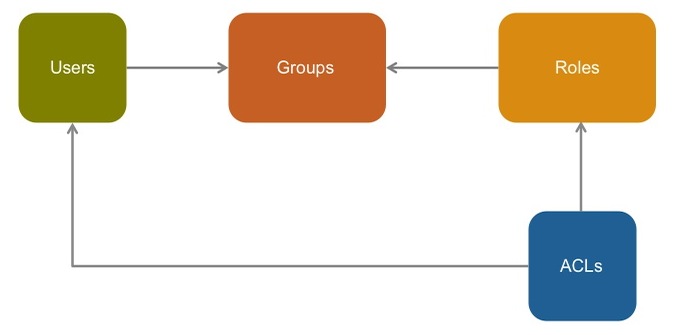
Governance of Clouds, Platform and Services
CumuLogic’s governance module is an integrated policy-driven and role-based access control system, which provides fine granular, role-based access to various cloud resources and maintains security of cloud resources and data.
Role-based Access Control
CumuLogic platform integrates with existing Active Directory and LDAP systems and allows you to extend your existing authentication, users’ roles and policies to the cloud – or create new roles, groups and criteria-based policies.
Several roles can be created and assigned appropriate Access Control List (ACLs) of private and public cloud resources, cloud services such as database services and actions on services such as backups and restores, API usage and any other custom resources.
You can create a number of roles for target audiences such as developers, QA, Ops personnel, etc. and assign them to different access levels of cloud resources. Roles can be assigned to specify groups of users or individual user accounts. For example, you want to create a role called QA for your QA team. QA team must be allowed to deploy applications for testing, provisioning resources such as databases and frameworks and also be able to configure/modify databases, initiate full backups of databases or restore from database snapshots. Also, you may want to limit the cloud or cloud region for QA, for instance, to only provision applications on Amazon cloud’s region US-East and internal private cloud in Silicon Valley datacenter. CumuLogic’s platform allows you to assign granular controls and extend or modify these controls in real time.
Quotas and Financial Controls
Quota and financial controls assign quantity or financial quotas in terms of cloud resources or usage amount. CumuLogic’s platform allows you to control expenses by individual project, group or role. You can assign budget codes to users, groups and roles and map them against your finance codes.
Auditing and Reporting
Using audit logs, you can track users and group activity across all the cloud resources. You can also register email notifications on specific user actions.
Geographical Policies
Geographical policies controls who can deploy applications or use what resources from which cloud. Geographical control allows you to maintain tighter security and compliance on restricted environments such as production systems or HR applications. It also allows enterprises to prevent inadvertently deploying sensitive, regulated applications on public clouds.
Entitlements
Entitlements control usage of cloud resources by registering users’ entitlements to certain services or certain clouds, storage and applications. Users will only be allowed to use the services or resources for what they are entitled to.
Use Cases
Hosted Web Applications
Large scale web applications require low latency and high performance application infrastructure services, such as NoSQL or SQL databases, elastic load balancers and large amounts of distributed cache. CumuLogic’s software suite provides all the infrastructure services for such large scale applications, so developers can quickly build and deploy complex architectures on any cloud. MySQL database service is commonly used in web applications since it can scale on demand to handle the peak workloads of essential applications. Developers can simply launch a single database instance and add read-only replicas at a time when their number of users is expected to grow and shut them down when the peak load has stabilized to lower levels again. This allows users to only pay for the extra database nodes when needed.
Disaster Recovery and Business Continuity
CumuLogic MySQL and MongoDB database services make it easy and cost-effective to architect Disaster Recovery (DR) architectures and a plan for mission critical applications. Enterprises are typically required to maintain one standby deployment environment to failover to in case of any downtime. With CumuLogic database services, it’s possible to launch a fully functioning database server on the cloud(s) within minutes, or a replica of a database server on alternate cloud or alternate availability zone on the same cloud. The replicas are fully synchronized and in the event of a downtime, applications can quickly use the replica database server nodes. If applications are deployed on CumuLogic PaaS, the platform will provision the applications on the alternate availability zone in case of failover. CumuLogic database service eliminates the need of highly expensive standby environments, lowering the overall cost of maintaining and implementing a DR plan.
Big Data Analysis
In modern applications, the data tends to be unstructured and in high volume. Such data can be generated by social applications or machines such as log files from web servers or debug data from large number of applications. Such data is usually required to be analyzed for further action by the applications. For example, analyzing web server log files to identify the demographics of the site visitors. Because of the unstructured nature of the data and its volume, developers prefer to use NoSQL daatabases such as MongoDB. Unlike relational databases such as MySQL, MongoDB can store unstructured data in the form of collections of JSON files. These files can then be analyzed by commonly available tools.
Development/QA/Test/Lab Environments for Enterprises
With a cloud powered by CumuLogic Cloud Services, you can help enterprise customers lower IT costs by offering Development/QA/Test/Lab environments on public clouds. Developers get access to self-service application infrastructure within seconds and deploy applications with a single click.
Managed Services for Hybrid Clouds
As CumuLogic’s software suite is available to build and deliver cloud services for on-premise datacenters, Cloud Providers with managed service offerings can offer hybrid cloud services based on the customer’s security, compliance or service level agreement (SLA) requirements. Additionally, Cloud Providers can manage a customer hybrid cloud from a single console greatly simplifying the cloud management.